
An introduction to Federated Learning

Federated learning makes it possible to build machine learning systems without direct access to training data. The data remains in its original location, which helps to ensure privacy and reduces communication costs.

This article is about the business case for federated learning. We’ll talk about how it works at a conceptual level, and then focus on the applications and use cases. Read More
#federated-learning, #machine-learning, #split-learning

Federated learning: distributed machine learning with data locality and privacy

We’re excited to release Federated Learning, the latest report and prototype from Cloudera Fast Forward Labs.

Federated learning makes it possible to build machine learning systems without direct access to training data. The data remains in its original location, which helps to ensure privacy and reduces communication costs. Read More

#federated-learning, #machine-learning, #split-learning

Communication-Efficient Learning of Deep Networks from Decentralized Data

Modern mobile devices have access to a wealth of data suitable for learning models, which in turn can greatly improve the user experience on the device. For example, language models can improve speech recognition and text entry, and image models can automatically select good photos. However, this rich data is often privacy sensitive, large in quantity, or both, which may preclude logging to the data center and training there using conventional approaches. We advocate an alternative that leaves the training data distributed on the mobile devices, and learns a shared model by aggregating locally-computed updates. We term this decentralized approach Federated Learning. Read More

#distributed-learning, #machine-learning, #split-learning

They will do more of the mundane tasks so humans don’t have to.

The next time you sit down to watch a movie, the algorithm behind your streaming service might recommend a blockbuster that was written by AI, performed by robots, and animated and rendered by a deep learning algorithm. An AI algorithm may have even read the script and suggested the studio buy the rights. Read More

#artificial-intelligence, #vfx

‘A.I.’ for VFX at SIGGRAPH Part 1

Artificial Intelligence (AI) is set to change the way VFX is approached and produced. At this year’s SIGGRAPH there are a series of key talks, papers and panels discussing applications of various forms of AI to VFX, by many of the biggest names in the Industry.

Doug Roble, Digital Domain’s senior director of software R&D, personally shares his thoughts on FUTURE ARTIFICIAL INTELLIGENCE AND DEEP LEARNING TOOLS FOR VFX. Read More

#artificial-intelligence, #vfx

Tomorrow’s VFX artists might not be human.

The next breakout star in Hollywood might be an AI named Arraiy. Arraiy is a computer vision and machine learning platform specifically designed for film and television effects. Read More

#unicorn, #vfx

The new Artificial Intelligence frontier of VFX

If there’s a buzz phrase right now in visual effects, it’s “machine learning.” In fact, there are three: machine learning, deep learning and artificial intelligence (A.I.). Each phrase tends to be used interchangeably to mean the new wave of smart software solutions in VFX, computer graphics and animation that lean on A.I. techniques.

Already, research in machine and deep learning has helped introduce both automation and more physically-based results in computer graphics, mostly in areas such as camera tracking, simulations, rendering, motion capture, character animation, image processing, rotoscoping and compositing. Read More

#artificial-intelligence, #deep-learning, #machine-learning, #vfx

Big data and machine learning: The perfect ingredients for cybersecurity

Protecting your business against hackers who are developing increasingly sophisticated strategies to bypass your security is growing even more challenging today. They’re also using machine learning on their side to:

  • Automate their attacks in a way that makes their breaches even harder to detect
  • Automate the victim selection process so they can tell who’s most vulnerable to their threats
  • Find weak points in your cyber defense system
  • Develop new ways to bypass your security software

This has created a never-ending battle between hackers and your defense systems that are growing more complex as AI fights against itself. To stay ahead of this “game” Inside Big Data says cyber defense systems must deploy machine learning algorithms that are at least as powerful and complex as what hackers are using, but preferably even stronger. Read More

#cyber

What is the difference between AI, machine learning and deep learning?

https://geospatialmedia.s3.amazonaws.com/wp-content/uploads/2017/05/AAEAAQAAAAAAAAhPAAAAJDlkMWMwNTA1LTZkZjUtNDA5MS1hYT.jpg

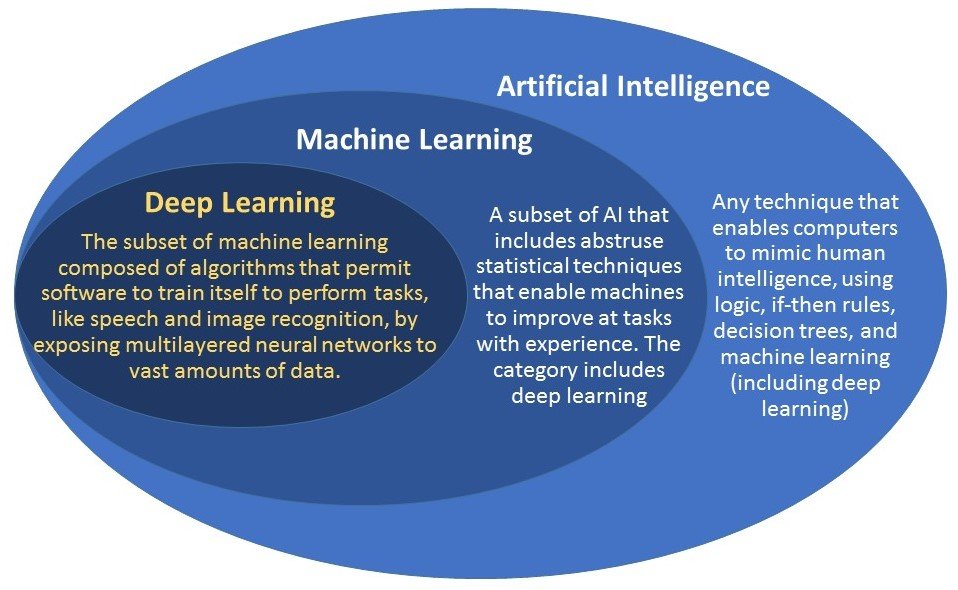
You can think of artificial intelligence (AI), machine learning and deep learning as a set of a matryoshka doll, also known as a Russian nesting doll. Deep learning is a subset of machine learning, which is a subset of AI. Read More

#artificial-intelligence, #deep-learning, #machine-learning

Painting Robots and the Artificial Intelligence behind their Creativity

#fake, #videos