There is considerable interest from policymakers and scientists around the world around how artificial intelligence is going to transform their work. In their haste to jump on the AI bandwagon, however, everybody is forgetting we have not solved some older, deeper problems about data that will stymie attempts to get the technology off the ground. Read More
Monthly Archives: August 2019
China’s AI Dreams Aren’t for Everyone
The Chinese government has big plans for artificial intelligence. Can it make them a reality in its education system?
One morning, Ming Ming wakes up for school to the soothing, mechanical voice of his artificially intelligent robot housekeeper. “Ming Ming! It’s March 29, 2028, and a new day has begun!”
This is not a work of science fiction. It is the opening chapter of a new Chinese high school textbook, put out by SenseTime, the world’s largest artificial intelligence start-up, with a valuation of over $4.5 billion, in partnership with a research center at East China Normal University and with middle and high school teachers in Shanghai. Published in April 2018, the textbook is part of the government’s recent push to prepare Chinese youth to help the nation become an AI superpower. Read More
NIST Lays Out Roadmap for Developing Artificial Intelligence Standards
Federal standards for artificial intelligence must be strict enough to prevent the tech from harming humans, yet flexible enough to encourage innovation and get the tech industry on board, according to the National Institute of Standards and Technology.
However, without better standards for measuring the performance and trustworthiness of AI tools, officials said, the government could have a tough time striking that balance.
On Monday, NIST released its much-anticipated guidance on how the government should approach developing technical and ethical standards for artificial intelligence. Read More
Big Data Makes Black Hat Hackers More Terrifying Than Ever
Big data is the lynchpin ofnew advances in cybersecurity. Unfortunately, predictive analytics and machine learning technology is a double-edged sword for cybersecurity. Hackers are also exploiting this technology, which means that there is a virtual arms race between cybersecurity companies and black hat cybercriminals.
Datanami has talked about the ways that hackers use big data to coordinate attacks. This should be a wakeup call to anybody that is not adequately prepared. Read More
How tech is transforming the Intelligence industry
At a conference on the future challenges of intelligence organizations held in 2018, former Director of National Intelligence Dan Coats argued that he transformation of the American intelligence community must be a revolution rather than an evolution. The community must be innovative and flexible, capable of rapidly adopting innovative technologies wherever they may arise.
Intelligence communities across the Western world are now at a crossroads: The growing proliferation of technologies, including artificial intelligence, Big Data, robotics, the Internet of Things, and blockchain, changes the rules of the game. The proliferation of these technologies – most of which are civilian, could create data breaches and lead to backdoor threats for intelligence agencies. Furthermore, since they are affordable and ubiquitous, they could be used for malicious purposes.
The technological breakthroughs of recent years have led intelligence organizations to challenge the accepted truths that have historically shaped their endeavors. The hierarchical, compartmentalized, industrial structure of these organizations is now changing, revolving primarily around the integration of new technologies with traditional intelligence work and the redefinition of the role of the humans in the intelligence process. Read More
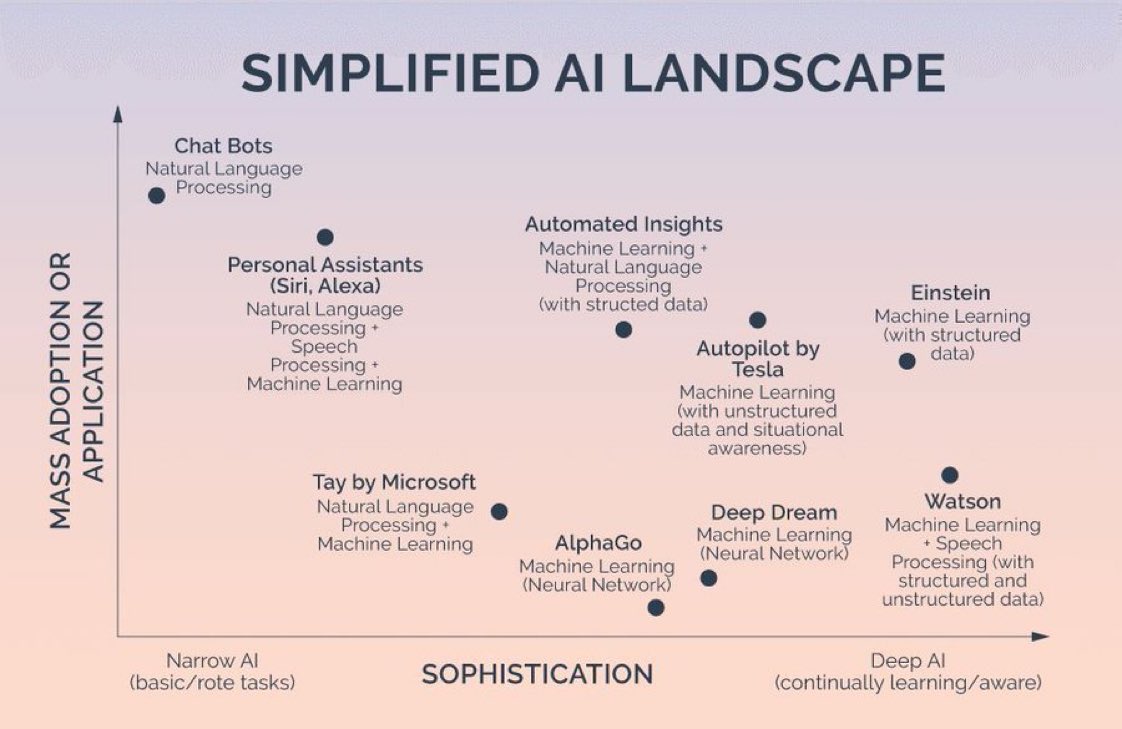
A simplified AI landscape

Galaxy Note 10 Plus 5G is the latest proof that 5G isn't for you — yet
Commentary: AT&T may be vindicated in withholding its 5G service from consumers so far.
AT&T has had, generously speaking, a mixed year when it comes to 5G. It kicked off 2019 by doubling down on its dubious 5GE claim, which misled consumers into thinking they had 5G, when they really were tapping into an advanced form of 4G that every other carrier already offered. After touting the launch of the world’s first 5G network in December, it still hasn’t made it available to anyone aside from select, friendly business customers. Even as Samsung launches its second 5G phone in the Galaxy Note 10 Plus 5G, AT&T has yet to launch its consumer service.
But, as odd as it sounds, AT&T may have been right all along. Read More
“reprogramming” the body’s so-called epigenetic marks
Juan Carlos Izpisúa Belmonte, working at the Gene Expression Laboratory at San Diego’s Salk Institute for Biological Studies, has discovered an age-reversal mixture, which works on mice. “It completely rejuvenates. If you look inside, obviously, all the organs, all the cells are younger.” The downside is that the mice either died after three or four days from cell malfunction or developed tumors that killed them later. An overdose of youth, you could call it. Read More
Intellectual Debt: With Great Power Comes Great Ignorance
What Technical Debt Can Teach Us About the Dangers of AI Working Too Well.
Harvard Professor Jonathan Zittrain uses technical debt to help understand “intellectual debt”: the idea that things work, even though we don’t understand precisely how. He points out that “While machine learning systems can surpass humans at pattern recognition and predictions, they generally cannot explain their answers in human-comprehensible terms.”
Why is this a problem? Because, “as AI’s intellectual debt piles up: the coming pervasiveness of machine learning models. Taken in isolation, oracular answers can generate consistently helpful results. But these systems won’t stay in isolation. As AI systems gather and ingest the world’s data, they’ll produce data of their own — much of which will be taken up by still other AI systems.” Read More
The brain inspires a new type of artificial intelligence
Machine learning, introduced 70 years ago, is based on evidence of the dynamics of learning in our brain. Using the speed of modern computers and large data sets, deep learning algorithms have recently produced results comparable to those of human experts in various applicable fields, but with different characteristics that are distant from current knowledge of learning in neuroscience.
Using advanced experiments on neuronal cultures and large scale simulations, a group of scientists at Bar-Ilan University in Israel has demonstrated a new type of ultrafast artifical intelligence algorithms — based on the very slow brain dynamics — which outperform learning rates achieved to date by state-of-the-art learning algorithms. Read More
 Rick's Cafe AI