
Monthly Archives: January 2021

Towards Broad AI & The Edge in 2021
There are those who debate whether the new decade of the 2020s commenced on 1 Jan 2020 or 1 Jan 2021. Either way, one suspects that many around the world will hope that at some point during the course of 2021 the current year will mark a shift away from the events of 2020 and allow for a new start. For a definition of AI, Machine Learning and Deep Learning see the Article an Intro to AI.
A new administration is in place in the US and the talk is about a major push for Green Technology and the need to stimulate next generation infrastructure including AI and 5G to generate economic recovery with David Knight forecasting that 5G has the potential – the potential – to drive GDP growth of 40% or more by 2030. The Biden administration has stated that it will boost spending in emerging technologies that includes AI and 5G to $300Bn over a four year period. Read More
AI: The Horsepower of the Future
The year 2021 may well see a turn in the trajectory of AI. As DataRobot notes in its predictions for the new year, “Within the enterprise, we finally expect a wholesale move from ‘Experimental AI’ to ‘Operational AI,’ as organizations must move out of the lab and beyond pure experimentation.” In fact, Gartner is forecasting that 75% of enterprises will shift from piloting to operationalizing AI by the end of 2024, driving a 5x increase in streaming data and analytics infrastructures.
From our perusal of the publications offering predictions in this space we see agreement that AI will be a bigger disruptor to business than the Internet was. Again, we ask: why? The simple answer may be that it offers such a wealth of opportunities to make better decisions, unearth hidden relationships previously unnoticed among critical data, and offer the agility and automation that our speed-obsessed times demand for competitiveness. AI is the new horsepower. Read More
8 reasons Python will rule the enterprise — and 8 reasons it won’t
The rise of Python will lead many enterprise managers to wonder whether it’s time to jump on the hype train. Let’s weigh the pros and cons.
There’s no question that Python is hugely popular with software developers, or that its popularity continues to rise. TIOBE, a software company that publishes a measure of the popularity of programming languages every month, reported in November that Python had climbed into the number two slot for the first time, passing Java.
… The rise of Python will lead many enterprise managers to wonder whether it’s time to jump on the hype train. To try to make sense of this impossible question, we’ve drawn up a list of eight reasons why joining the crowd is smart and eight other reasons why you might want to wait a few decades. Read More
A fridge that’s colder than outer space could take quantum computing to new heights
Quantum computing is nearing a ‘tipping point’, says CEO of Oxford Quantum Circuits. The arrival of powerful new refrigerators will allow organizations to take quantum computing to new heights, by improving the “quality” of superconducting quantum bits (qubits). Read More
Who Is Winning the AI Race: China, the EU, or the United States?
The nations that lead in the development and use of artificial intelligence (AI) will shape the future of the technology and significantly improve their economic competitiveness, while those that fall behind risk losing competitiveness in key industries. As a result, more than 30 nations have created national AI strategies to improve their prospects. To date, the United States has emerged as the early frontrunner in AI, but China is challenging its lead.
This report examines the progress China, the European Union, and the United States have made in AI relative to each other in recent years and provides an update on a report released on their comparative rankings from 2019. It finds that the United States still holds a substantial overall lead, but that China has continued to reduce the gap in some important areas. In addition, the EU continues to fall behind. Absent significant policy changes in both the EU and United States—particularly the EU changing its regulatory system to be more innovation-friendly, and the United States developing and funding a more proactive national AI strategy—it is likely that the EU will remain behind both the United States and China, and that China will eventually close the gap with the United States. Read More
National AI strategies – A summary of major initiatives
AI is central to the future competitiveness of nations. Here is a summary of the major initiatives from nations who have declared a national AI strategy. I have listed the original source at the end of the blog. I have added some links in the case of each nation which I found interesting. Read More
Data Science & Machine Learning Book Available for Download
A comprehensive textbook intended for students interested in gaining a better understanding of the mathematics and statistics that underpin the rich variety of ideas and machine learning algorithms in data science free for download. Read More

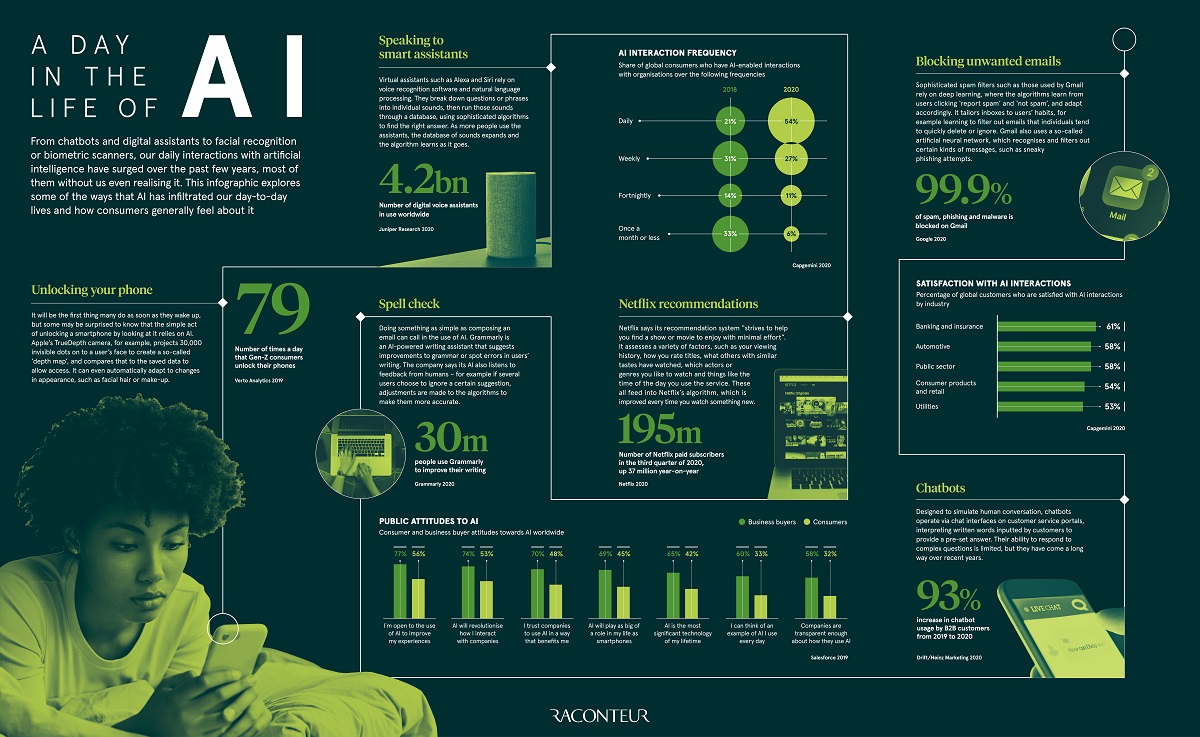
A day in the life of AI
This Chinese Lab Is Aiming for Big AI Breakthroughs
China produces as many artificial intelligence researchers as the US, but it lags in key fields like machine learning. The government hopes to make up ground.
In a low-rise building overlooking a busy intersection in Beijing, Ji Rong Wen, a middle-aged scientist with thin-rimmed glasses and a mop of black hair, excitedly describes a project that could advance one of the hottest areas of artificial intelligence.
Wen leads a team at the Beijing Academy of Artificial Intelligence (BAAI), a government-sponsored research lab that’s testing a powerful new language algorithm—something similar to GPT-3, a program revealed in June by researchers at OpenAI that digests large amounts of text and can generate remarkably coherent, free-flowing language. “This is a big project,” Wen says with a big grin. “It takes a lot of computing infrastructure and money.” Read More
 Rick's Cafe AI