

In 2019, a source came to us with a digital file containing the precise locations of more than 12 million individual smartphones for several months in 2016 and 2017. The data is supposed to be anonymous, but it isn’t. We found celebrities, Pentagon officials and average Americans.
… A source has provided another data set, this time following the smartphones of thousands of Trump supporters, rioters and passers-by in Washington, D.C., on January 6, as Donald Trump’s political rally turned into a violent insurrection. At least five people died because of the riot at the Capitol. Key to bringing the mob to justice has been the event’s digital detritus: location data, geotagged photos, facial recognition, surveillance cameras and crowdsourcing. Read More
Daily Archives: February 5, 2021
Fractals can help AI learn to see more clearly—or at least more fairly
Large datasets like ImageNet have supercharged the last 10 years of AI vision, but they are hard to produce and contain bias. Computer generated datasets provide an alternative.
Most image-recognition systems are trained using large databases that contain millions of photos of everyday objects, from snakes to shakes to shoes. With repeated exposure, AIs learn to tell one type of object from another. Now researchers in Japan have shown that AIs can start learning to recognize everyday objects by being trained on computer-generated fractals instead.
It’s a weird idea but it could be a big deal. Generating training data automatically is an exciting trend in machine learning. And using an endless supply of synthetic images rather than photos scraped from the internet avoids problems with existing hand-crafted data sets. Read More
This is how we lost control of our faces
In 1964, mathematician and computer scientist Woodrow Bledsoe first attempted the task of matching suspects’ faces to mugshots. He measured out the distances between different facial features in printed photographs and fed them into a computer program. His rudimentary successes would set off decades of research into teaching machines to recognize human faces.
Now a new study shows just how much this enterprise has eroded our privacy. It hasn’t just fueled an increasingly powerful tool of surveillance. The latest generation of deep-learning-based facial recognition has completely disrupted our norms of consent. Read More
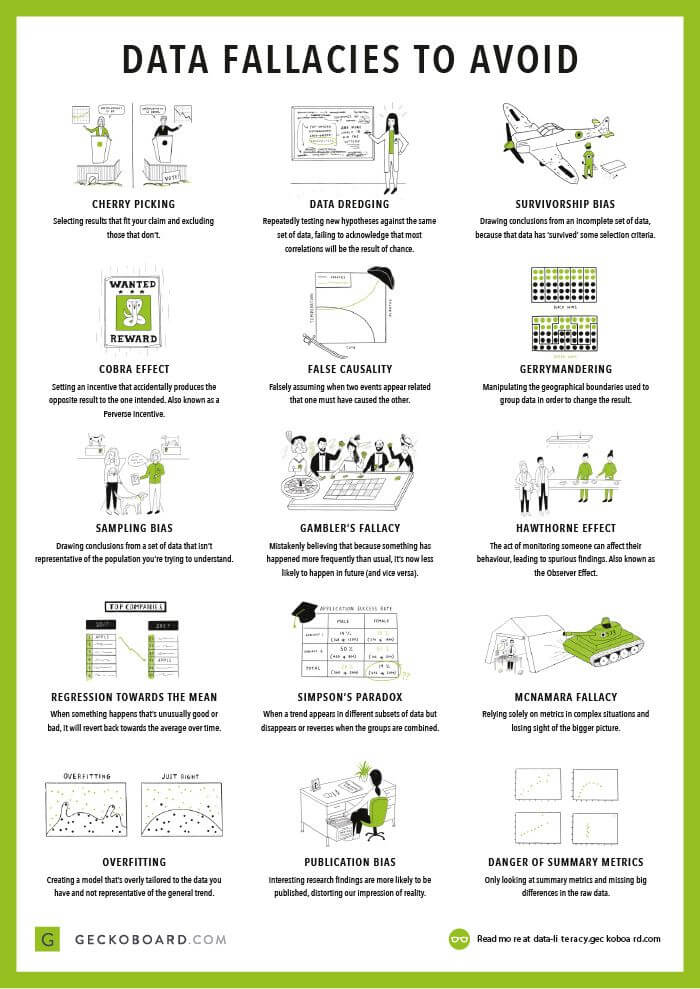
Data fallacies
Statistical fallacies are common tricks data can play on you, which lead to mistakes in data interpretation and analysis. Explore some common fallacies, with real-life examples, and find out how you can avoid them. Read More
Artificial intelligence in longevity medicine
Recent advances in deep learning enabled the development of AI systems that outperform humans in many tasks and have started to empower scientists and physicians with new tools. In this Comment, we discuss how recent applications of AI to aging research are leading to the emergence of the field of longevity medicine. Read More
AI chips in the real world: Interoperability, constraints, cost, energy efficiency, and models
The answer to the question of how to make the best of AI hardware may not be solely, or even primarily, related to hardware
How do you make the best out of the proliferating array of emerging custom silicon hardware while not spreading yourself thin to keep up with each and every one of them?
If we were to put a price tag on that question, it would be in the multi-billion dollar territory. That’s what the combined estimated value of the different markets it touches upon is. As AI applications are exploding, so is the specialized hardware that supports them. Read More
Build Your First Image Classifier With Convolutional Neural Network (CNN)
A Beginners Guide to CNN with TensorFlow
Convolutional Neural Network (CNN) is a type of deep neural network primarily used in image classification and computer vision applications. This article will guide you through creating your own image classification model by implementing CNN using the TensorFlow package in Python. Read More
Artificial Intelligence is a Supercomputing problem
The next generation of Artificial Intelligence applications impose new and demanding computing infrastructures. How are the computer systems that support artificial intelligence? How did we get here? Who has access to these systems? What is our responsibility as Artificial Intelligence practitioners?
[These posts will be used in the master course Supercomputers Architecture at UPC Barcelona Tech with the support of the BSC]
Part 1
Part 2
 Rick's Cafe AI