

In 1964, mathematician and computer scientist Woodrow Bledsoe first attempted the task of matching suspects’ faces to mugshots. He measured out the distances between different facial features in printed photographs and fed them into a computer program. His rudimentary successes would set off decades of research into teaching machines to recognize human faces.
Now a new study shows just how much this enterprise has eroded our privacy. It hasn’t just fueled an increasingly powerful tool of surveillance. The latest generation of deep-learning-based facial recognition has completely disrupted our norms of consent. Read More
Monthly Archives: February 2021
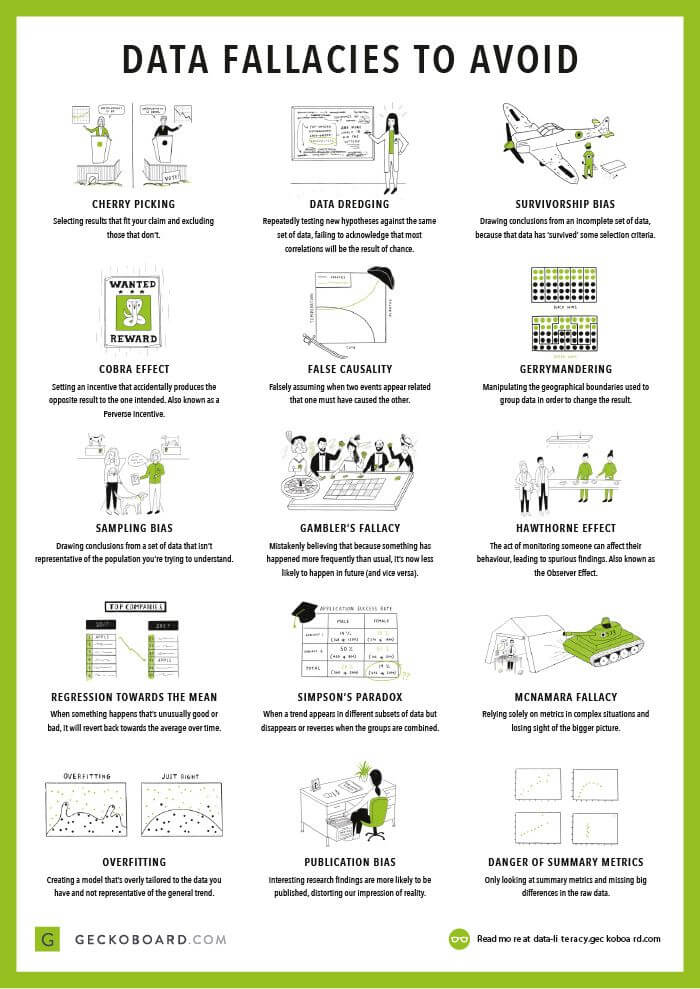
Data fallacies
Statistical fallacies are common tricks data can play on you, which lead to mistakes in data interpretation and analysis. Explore some common fallacies, with real-life examples, and find out how you can avoid them. Read More
Artificial intelligence in longevity medicine
Recent advances in deep learning enabled the development of AI systems that outperform humans in many tasks and have started to empower scientists and physicians with new tools. In this Comment, we discuss how recent applications of AI to aging research are leading to the emergence of the field of longevity medicine. Read More
AI chips in the real world: Interoperability, constraints, cost, energy efficiency, and models
The answer to the question of how to make the best of AI hardware may not be solely, or even primarily, related to hardware
How do you make the best out of the proliferating array of emerging custom silicon hardware while not spreading yourself thin to keep up with each and every one of them?
If we were to put a price tag on that question, it would be in the multi-billion dollar territory. That’s what the combined estimated value of the different markets it touches upon is. As AI applications are exploding, so is the specialized hardware that supports them. Read More
Build Your First Image Classifier With Convolutional Neural Network (CNN)
A Beginners Guide to CNN with TensorFlow
Convolutional Neural Network (CNN) is a type of deep neural network primarily used in image classification and computer vision applications. This article will guide you through creating your own image classification model by implementing CNN using the TensorFlow package in Python. Read More
Artificial Intelligence is a Supercomputing problem
The next generation of Artificial Intelligence applications impose new and demanding computing infrastructures. How are the computer systems that support artificial intelligence? How did we get here? Who has access to these systems? What is our responsibility as Artificial Intelligence practitioners?
[These posts will be used in the master course Supercomputers Architecture at UPC Barcelona Tech with the support of the BSC]
Part 1
Part 2
Stanford MLSys Seminars
New MIT brain research shows how AI could help us understand consciousness
A team of researchers from MIT and Massachusetts General Hospital recently published a study linking social awareness to individual neuronal activity. To the best of our knowledge, this is the first time evidence for the ‘theory of mind‘ has been identified at this scale. Read More
Read the paper.
CrypTen – A Research Tool for Secure and Privacy – Preserving Machine Learning in Pytorch
Facebook’s Pytorch had created a huge buzz in the market when it was released five years ago. Now, it is not only the most preferred frameworks for Machine Learning and Deep Learning models but also one of the most powerful tools in research to develop new libraries and frameworks(like Huggingface, Fast.ai, etc). One of the most captivating libraries released by Facebook’s AI Research Lab(FAIR) is CrypTen – a tool for secure computation in ML. CrypTen is an open-source Python framework, built on Pytorch, to provide secure and privacy-preserving machine learning.
Crypten serves Secure Multiparty Computation as its secured computing backend and lessens the gap between ML researchers/developers and cryptography by facilitating Pytorch API’s to perform encryption techniques. Read More
Artificial Intelligence in Research: Where do China and USA stand?
What’s the current situation of Artificial Intelligence in the Research and funding sector?
Today, we are on the cusp of witnessing a widespread implementation of artificial intelligence (AI) across several sectors. As artificial intelligence technologies are pushing the frontiers of usability and innovation, countries are racing to diffuse its applications on public, private and social front. While we inch close to achieving total disruption, artificial intelligence becomes a key driver of productivity and GDP growth for every nation. With the USA and China having occupied the leading ranks in AI research, nations like the UK, Singapore, Japan, Brazil, India and others are striving to etch themselves on global map.
… Nations like India, Japan are powerhouses of digital data. However, according to a new report from the Center for Data Innovation, USA still holds a substantial lead globally. With tech behemoths like Amazon, Google, Microsoft, Facebook and IBM investing heavily in artificial intelligence, the USA still managed to hold the axial position in AI research.
An article in Tech Wire Asia reveals that thanks to beaming investment in startups and research and development funding, the USA achieved an overall score of 44.6 points in a new study by the Information Technology and Innovation Foundation (ITIF). Read More
 Rick's Cafe AI