Homemade Machine Learning

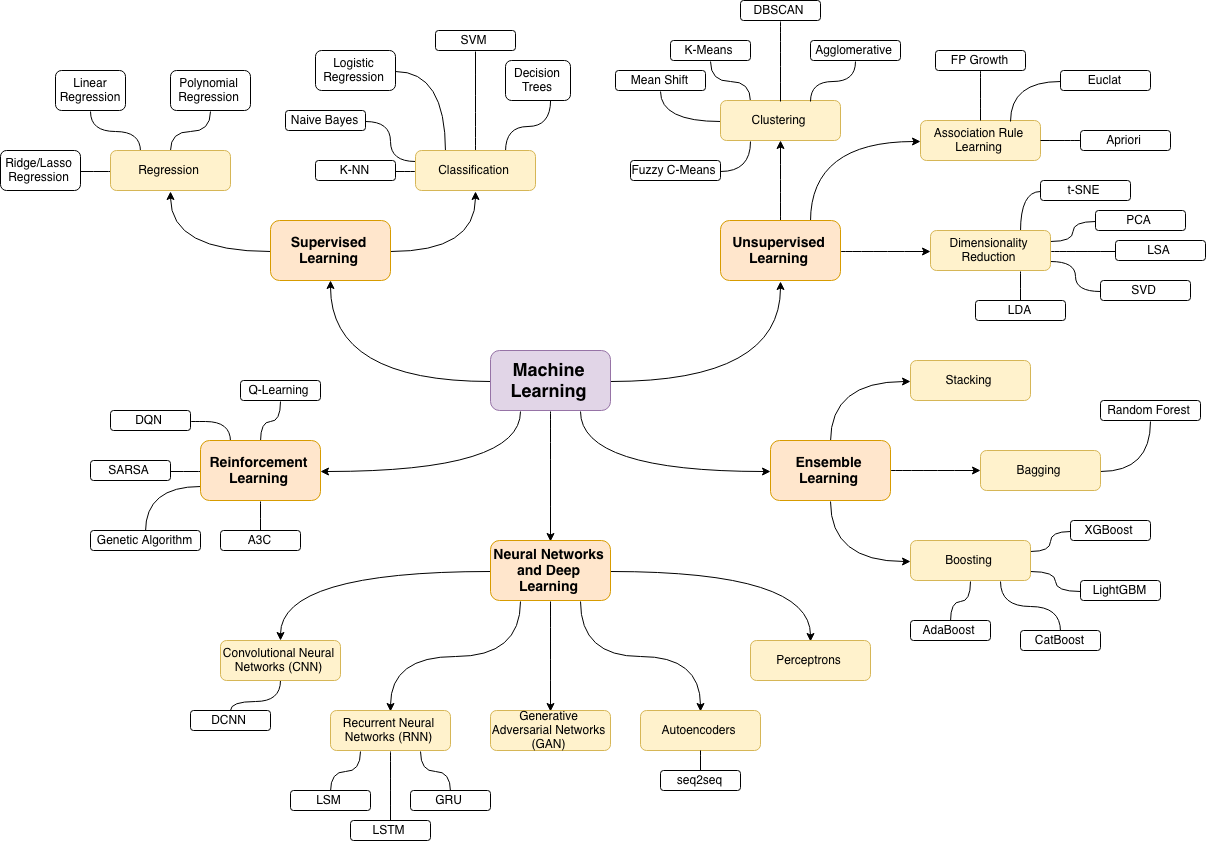
The purpose of this repository is not to implement machine learning algorithms by using 3rd party library one-liners but rather to practice implementing these algorithms from scratch and get better understanding of the mathematics behind each algorithm. That’s why all algorithms implementations are called “homemade” and not intended to be used for production.

machine-learning-map.png
Read More

#machine-learning, #python

Adobe Photoshop uses AI to quadruple your photo’s size

Super resolution blows up a 12-megapixel smartphone photo into a much larger 48-megapixel shot. It’s coming to Lightroom soon, too.

#image-recognition

Artificial intelligence leads NATO’s new strategy for emerging and disruptive tech

NATO and its member nations have formally agreed upon how the alliance should target and coordinate investments in emerging and disruptive technology, or EDT, with plans to release artificial intelligence and data strategies by the summer of 2021.

In recent years the alliance has publicly declared its need to focus on so-called EDTs, and identified seven science and technology areas that are of direct interest. Now, the NATO enterprise and representatives of its 30 member states have endorsed a strategy that shows how the alliance can both foster these technologies — through stronger relationships with innovation hubs and specific funding mechanisms — and protect EDT investments from outside influence and export issues. Read More

#dod

Multi-modal Self-Supervision from Generalized Data Transformations

The recent success of self-supervised learning can be largely attributed to content-preserving transformations, which can be used to easily induce invariances. While transformations generate positive sample pairs in contrastive loss training, most recent work focuses on developing new objective formulations, and pays rela-tively little attention to the transformations themselves. In this paper, we introduce the framework of Generalized Data Transformations to (1) reduce several recent self-supervised learning objectives to a single formulation for ease of comparison,analysis, and extension, (2) allow a choice between being invariant or distinctive to data transformations, obtaining different supervisory signals, and (3) derive the conditions that combinations of transformations must obey in order to lead to well-posed learning objectives. This framework allows both invariance and distinctiveness to be injected into representations simultaneously, and lets us systematically explore novel contrastive objectives. We apply it to study multi-modal self-supervision for audio-visual representation learning from unlabelled videos,improving the state-of-the-art by a large margin, and even surpassing supervised pretraining. We demonstrate results on a variety of downstream video and audio classification and retrieval tasks, on datasets such as HMDB-51, UCF-101,DCASE2014, ESC-50 and VGG-Sound. In particular, we achieve new state-of-the-art accuracies of 72.8% on HMDB-51 and 95.2% on UCF-101. Read More

#image-recognition, #self-supervised

Facebook’s next big AI project is training its machines on users’ public videos

AI that can understand video could be put to a variety of uses

Teaching AI systems to understand what’s happening in videos as completely as a human can is one of the hardest challenges — and biggest potential breakthroughs — in the world of machine learning. Today, Facebook announced a new initiative that it hopes will give it an edge in this consequential work: training its AI on Facebook users’ public videos.

Access to training data is one of the biggest competitive advantages in AI, and by collecting this resource from millions and millions of their users, tech giants like Facebook, Google, and Amazon have been able to forge ahead in various areas. And while Facebook has already trained machine vision models on billions of images collected from Instagram, it hasn’t previously announced projects of similar ambition for video understanding. Read More

#image-recognition

After Neoliberalism

At the heart of the new age are novel configurations of fear, certainty, and power.

Shoshana Zuboff. The Age of Surveillance Capitalism. Public Affairs, 2019.

Today there is no more powerful corporation in the world than Google, so it may be hard to remember that not too long ago, the company was in a fight for its very existence. In its early years, Google couldn’t figure out how to make money. … Google engineers were aware that users’ search queries produced a great deal of “collateral data,” which they collected as a matter of course. Data logs revealed not only common keywords, but also dwell times and click patterns. This “data exhaust,” it began to dawn on some of Google’s executives, could be an immensely valuable resource for the company, since the data contained information that advertisers could use to target consumers. Read More

#big7, #books

Inside Facebook Reality Labs: The Next Era of Human-Computer Interaction

Facebook Reality Labs (FRL) Chief Scientist Michael Abrash has called AR interaction “one of the hardest and most interesting multi-disciplinary problems around,” because it’s a complete paradigm shift in how humans interact with computers. The last great shift began in the 1960s when Doug Engelbart’s team invented the mouse and helped pave the way for the graphical user interfaces (GUIs) that dominate our world today. The invention of the GUI fundamentally changed HCI for the better — and it’s a sea change that’s held for decades.

But all-day wearable AR glasses require a new paradigm because they will be able to function in every situation you encounter in the course of a day. They need to be able to do what you want them to do and tell you what you want to know when you want to know it, in much the same way that your own mind works — seamlessly sharing information and taking action when you want it, and not getting in your way otherwise. Read More

#big7, #human

How Facebook got addicted to spreading misinformation

The company’s AI algorithms gave it an insatiable habit for lies and hate speech. Now the man who built them can’t fix the problem.

It was March 23, 2018, just days after the revelation that Cambridge Analytica, a consultancy that worked on Donald Trump’s 2016 presidential election campaign, had surreptitiously siphoned the personal data of tens of millions of Americans from their Facebook accounts in an attempt to influence how they voted. It was the biggest privacy breach in Facebook’s history. …The Cambridge Analytica scandal would kick off Facebook’s largest publicity crisis ever. Read More

#big7, #ethics, #surveillance

How To Kill Bitcoin: Is Bitcoin ‘Unstoppable Code’?

They say Bitcoin can’t be stopped.Just like there’s no way you can stop two people sending encrypted messages to each other, so — they say — there’s no way you can stop the Bitcoin network.

There’s no CEO to put on trial, no central server to seize, and no organisation to put pressure on. The Bitcoin network is, fundamentally, just people sending messages to each other, peer to peer, and if you knock out 1 node on the network, or even 1,000 nodes, the honey badger don’t give a shit: the other 10,000+ nodes keep going like nothing happened, and more nodes can come online at any time, anywhere in the world.

So there you have it: it’s thousands of people running nodes — running code — and it’s unstoppable… therefore Bitcoin is unstoppable code; Q.E.D.; case closed; no further questions Your Honour. This money is above the law, and governments cannot possibly hope to control it, right?

Wrong. Read More: … Part 1Part 2

#blockchain

Neural Body: Implicit Neural Representations with Structured Latent Codes for Novel View Synthesis of Dynamic Humans

This paper addresses the challenge of novel view synthe-sis for a human performer from a very sparse set of cameraviews. Some recent works have shown that learning implicitneural representations of 3D scenes achieves remarkableview synthesis quality given dense input views. However,the representation learning will be ill-posed if the views arehighly sparse. To solve this ill-posed problem, our key ideais to integrate observations over video frames. To this end,we propose Neural Body, a new human body representationwhich assumes that the learned neural representations atdifferent frames share the same set of latent codes anchoredto a deformable mesh, so that the observations acrossframes can be naturally integrated. The deformable meshalso provides geometric guidance for the network to learn3D representations more efficiently. Experiments on a newlycollected multi-view dataset show that our approach out-performs prior works by a large margin in terms of the viewsynthesis quality. We also demonstrate the capability of ourapproach to reconstruct a moving person from a monocularvideo on the People-Snapshot dataset. The code and datasetwill be available at https://zju3dv.github.io/neuralbody/. Read More

#image-recognition