

ZipRecruiter, CareerBuilder, LinkedIn—most of the world’s biggest job search sites use AI to match people with job openings. But the algorithms don’t always play fair.
Years ago, LinkedIn discovered that the recommendation algorithms it uses to match job candidates with opportunities were producing biased results. The algorithms were ranking candidates partly on the basis of how likely they were to apply for a position or respond to a recruiter. The system wound up referring more men than women for open roles simply because men are often more aggressive at seeking out new opportunities.
LinkedIn discovered the problem and built another AI program to counteract the bias in the results of the first. Meanwhile, some of the world’s largest job search sites—including CareerBuilder, ZipRecruiter, and Monster—are taking very different approaches to addressing bias on their own platforms, as we report in the newest episode of MIT Technology Review’s podcast “In Machines We Trust.” Read More
Monthly Archives: June 2021
Why scientists think this hack is crucial for lifelong learning
In season two of the show 30 Rock, Tina Fey’s character Liz Lemon says to her boss, “I have to do that thing rich people do, where they turn money into more money.” While our brains can’t passively invest in stocks for us and watch the money grow, they can do almost exactly that when working on a new skill: turn learning into more learning.
All you have to do is sit back and relax.
This is exemplified by a study published June 8 in Cell Reports. Scientists examined the fluctuating magnetic fields in the brains of participants asked to perform a sequential task repeatedly. They observed that in the brief breaks between the practice rounds, that task was replayed rapidly in their minds as if learning on its own. Read More
The Memo
In 2002, Amazon’s Jeff Bezos issued a memo that has entered tech industry canon. The memo, known as the “API Mandate”, is generally perceived as being a statement about technology at Amazon, and is therefore widely admired by technologists and wholly ignored by executives. This is unfortunate, because it’s no exaggeration to say that the API Mandate completely transformed Amazon as a business and laid the foundation for its success. Better still, unlike many things that global technology titans do, it is something that can be replicated and put to use by almost any business.
In this post, we’ll talk about the memo, and how it created the systems and incentives for radical organisational transformation. Read More
NIST Proposes Method for Evaluating User Trust in Artificial Intelligence Systems
Can trust, one of the primary bases of relationships throughout history, be quantified and measured?
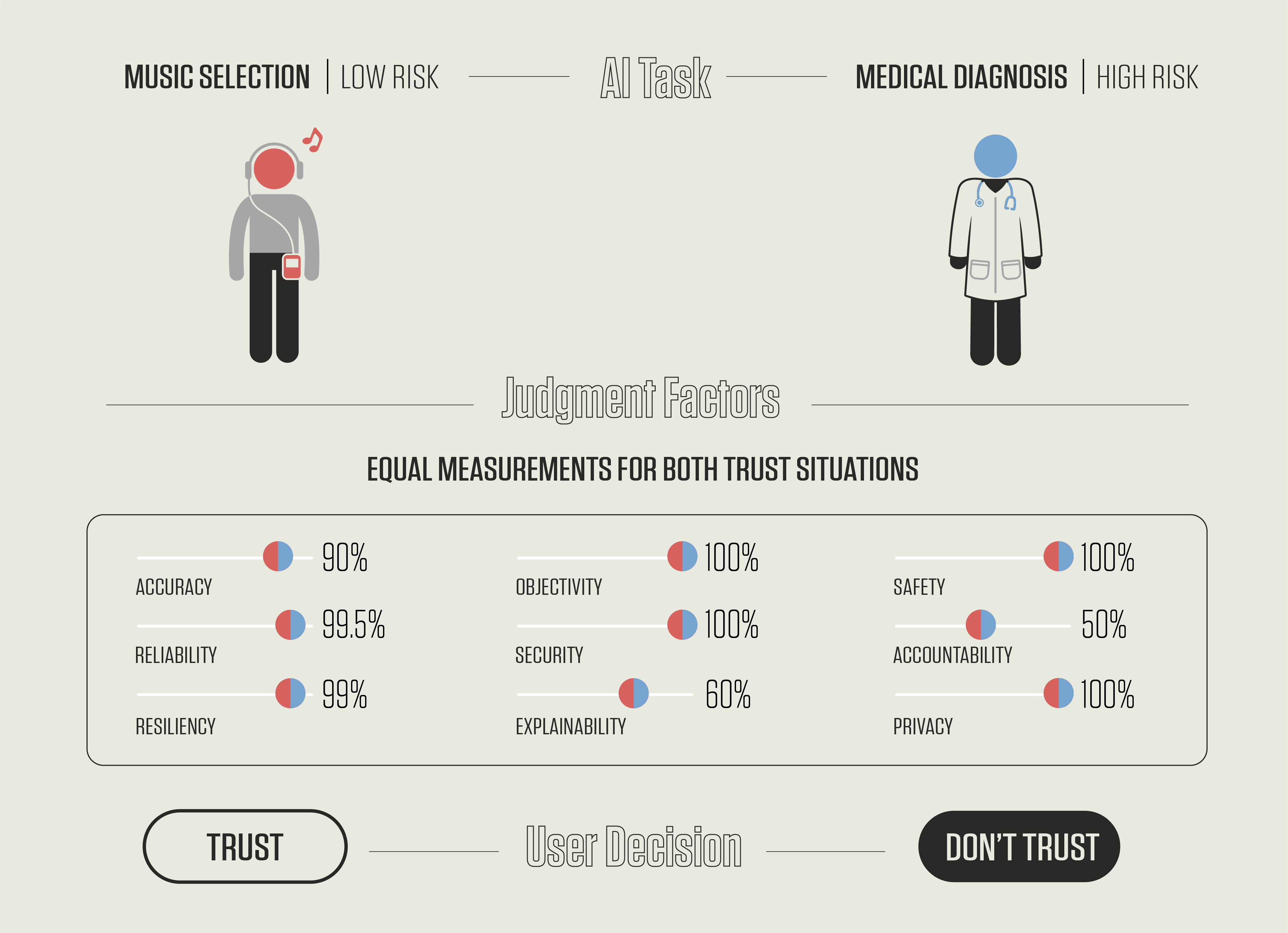
Every time you speak to a virtual assistant on your smartphone, you are talking to an artificial intelligence — an AI that can, for example, learn your taste in music and make song recommendations that improve based on your interactions. However, AI also assists us with more risk-fraught activities, such as helping doctors diagnose cancer. These are two very different scenarios, but the same issue permeates both: How do we humans decide whether or not to trust a machine’s recommendations?
This is the question that a new draft publication from the National Institute of Standards and Technology (NIST) poses, with the goal of stimulating a discussion about how humans trust AI systems. The document, Artificial Intelligence and User Trust (NISTIR 8332), is open for public comment until July 30, 2021. Read More
Reward is enough
In this article we hypothesise that intelligence, and its associated abilities, can be understood as subserving the maximisation of reward. Accordingly, reward is enough to drive behaviour that exhibits abilities studied in natural and artificial intelligence, including knowledge, learning, perception, social intelligence, language, generalisation and imitation. This is in contrast to the view that specialised problem formulations are needed for each ability, based on other signals or objectives. Furthermore, we suggest that agents that learn through trial and error experience to maximise reward could learn behaviour that exhibits most if not all of these abilities, and therefore that powerful reinforcement learning agents could constitute a solution to artificial general intelligence. Read More
#gans, #reinforcement-learningA Clever Robot Spies on Creatures in the Ocean’s ‘Twilight Zone’
Mesobot looks like a giant AirPods case, but it’s in fact a sophisticated machine that tracks animals making the most epic migration on Earth.
The grandest migration on Earth isn’t the journey of some herbivore in Africa or a bird in the sky, but the vertical movement of whole ecosystems in the open ocean. All kinds of animals, from fish to crustaceans, hang out in the depths during the day, where the darkness provides protection from predators. At night, they migrate up to the shallows to forage. Then they swim back down again when the sun rises—a great big conveyor belt of biomass.
But now a spy swims among them: Mesobot. Today in the journal Science Robotics, a team of engineers and oceanographers describes how they got a new autonomous underwater vehicle to lock onto movements of organisms and follow them around the ocean’s “twilight zone,” a chronically understudied band between 650 feet and 3,200 feet deep, which scientists also refer to as mid-water. Thanks to some clever engineering, the researchers did so without flustering these highly sensitive animals, making Mesobot a groundbreaking new tool for oceanographers. Read More
Is ‘brain drift’ the key to machine consciousness?
Could this currently inexplicable phenomenon be what’s keeping our robots from experiencing reality?
Think about someone you love and the neurons in your brain will light up like a Christmas tree. But if you think about them again, will the same lights go off? Chances are: the answer’s no. And that could have big implications for the future of AI.
A team of neuroscientists from the University of Columbia in New York recently published research demonstrating what they refer to as “representational drift” in the brains of mice. Read More
Which VPN Providers Really Take Privacy Seriously in 2021?
Choosing the right VPN can be a tricky endeavor. There are hundreds of VPN services out there, all promising to keep you private but some are more private than others. To help you pick the best one for your needs, we asked dozens of VPNs to detail their logging practices, how they handle torrent users, and what else they do to keep you as anonymous as possible.
… We don’t want to make any recommendations. When it comes to privacy and anonymity, an outsider can’t offer any guarantees. Vulnerabilities are always lurking around the corner and even with the most secure VPN, you still have to trust the VPN company with your data.
Instead, we aim to provide an unranked overview of VPN providers, asking them questions we believe are important. Many of these questions relate to privacy and security, and the various companies answer them in their own words. Read More
Full Page Handwriting Recognition via Image to Sequence Extraction
We present a Neural Network based Handwritten Text Recognition (HTR) model architecture that can be trained to recognize full pages of handwritten or printed text without image segmentation. Being based on Image to Sequence architecture, it can extract text present in an image and then sequence it correctly without imposing any constraints regarding orientation, layout and size of text and non-text. Further, it can also be trained to generate auxiliary markup related to formatting,layout and content. We use character level vocabulary, thereby enabling language and terminology of any subject. The model achieves a new state-of-art in paragraph level recognition on the IAM dataset. When evaluated on scans of real world handwritten free form test answers -beset with curved and slanted lines, drawings, tables, math, chemistry and other symbols – it performs better than all commercially available HTR cloud APIs. It is deployed in production as part of a commercial web application. Read More
Facebook develops new method to reverse-engineer deepfakes and track their source
Deepfakes aren’t a big problem on Facebook right now, but the company continues to fund research into the technology to guard against future threats. Its latest work is a collaboration with academics from Michigan State University (MSU), with the combined team creating a method to reverse-engineer deepfakes: analyzing AI-generated imagery to reveal identifying characteristics of the machine learning model that created it.
The work is useful as it could help Facebook track down bad actors spreading deepfakes on its various social networks. This content might include misinformation but also non-consensual pornography — a depressingly common application of deepfake technology. Right now, the work is still in the research stage and isn’t ready to be deployed. Read More
 Rick's Cafe AI