Artificial Intelligence (AI) or machine learning is being used by military intelligence and at the high strategic level. The question is whether this technology will ever filter down to the soldier actually doing the fighting on the ground? Science fiction novels and movies suggest a system that can communicate with a warfighter in real time and provide situational awareness, but how far is the fiction from reality?
“The most important weapon is situation awareness, and there are AI-based tools to help a lot with this,” explained Jim Purtilo, associate professor of computer science at the University of Maryland. Read More
Tag Archives: Artificial Intelligence
What Will Our Society Look Like When Artificial Intelligence Is Everywhere?
In June of 1956, A few dozen scientists and mathematicians from all around the country gathered for a meeting on the campus of Dartmouth College. Most of them settled into the red-bricked Hanover Inn, then strolled through the famously beautiful campus to the top floor of the math department, where groups of white-shirted men were already engaged in discussions of a “strange new discipline”—so new, in fact, that it didn’t even have a name. “People didn’t agree on what it was, how to do it or even what to call it,” Grace Solomonoff, the widow of one of the scientists, recalled later. The talks—on everything from cybernetics to logic theory—went on for weeks, in an atmosphere of growing excitement.
What the scientists were talking about in their sylvan hideaway was how to build a machine that could think. Read More
Software Ate The World, Now AI Is Eating Software
Marc Andreessen famously said that “Software is eating the world” and everyone gushed into the room. This was as much a writing on the wall for many traditional enterprises as it was wonderful news for the software industry.
…Little did Andreessen envision that the same software industry could be at risk of being eaten.
Fast forward to 2019 and the very same software industry is nervous. Very very nervous!
And the reason is AI. Read More
Philosophy will be the key that unlocks artificial intelligence
To state that the human brain has capabilities that are, in some respects, far superior to those of all other known objects in the cosmos would be uncontroversial. The brain is the only kind of object capable of understanding that the cosmos is even there, or why there are infinitely many prime numbers, or that apples fall because of the curvature of space-time, or that obeying its own inborn instincts can be morally wrong, or that it itself exists. Nor are its unique abilities confined to such cerebral matters. The cold, physical fact is that it is the only kind of object that can propel itself into space and back without harm, or predict and prevent a meteor strike on itself, or cool objects to a billionth of a degree above absolute zero, or detect others of its kind across galactic distances. Read More
What is Amazon Go, where is it, and how does it work?
Amazon will be opening more Amazon Go stores in the US and UK during 2019 – the latest rumour is that Amazon has now settled on a London site.
Amazon Go gives you the option to buy your goods from Amazon in person rather than through Amazon.com.
However, unlike other physical shops, it doesn’t have any registers or checkouts. You simply walk in, pick out what you want and walk out. Amazon is calling this a “Just Walk Out” shopping experience. Read More
The Anthropologist of Artificial Intelligence
How do new scientific disciplines get started? For Iyad Rahwan, a computational social scientist with self-described “maverick” tendencies, it happened on a sunny afternoon in Cambridge, Massachusetts, in October 2017. Rahwan and Manuel Cebrian, a colleague from the MIT Media Lab, were sitting in Harvard Yard discussing how to best describe their preferred brand of multidisciplinary research. The rapid rise of artificial intelligence technology had generated new questions about the relationship between people and machines, which they had set out to explore. Rahwan, for example, had been exploring the question of ethical behavior for a self-driving car — should it swerve to avoid an oncoming SUV, even if it means hitting a cyclist? — in his Moral Machine experiment.
“I was good friends with Iain Couzin, one of the world’s foremost animal behaviorists,” Rahwan said, “and I thought, ‘Why isn’t he studying online bots? Why is it only computer scientists who are studying AI algorithms?’
“All of a sudden,” he continued, “it clicked: We’re studying behavior in a new ecosystem.”
Two years later, Rahwan, who now directs the Center for Humans and Machines at the Max Planck Institute for Human Development, has gathered 22 colleagues — from disciplines as diverse as robotics, computer science, sociology, cognitive psychology, evolutionary biology, artificial intelligence, anthropology and economics — to publish a paper in Nature calling for the inauguration of a new field of science called “machine behavior.” Read More
A GUIDE TO NOT KILLING OR MUTILATING ARTIFICIAL INTELLIGENCE RESEARCH
What’s the fastest way to build a jig-saw puzzle? That was the question posed by Michael Polanyi in 1962. An obvious answer is to enlist help. In what way, then, could the helpers be coordinated most efficiently? If you divided pieces between the helpers, then progress would slow to a crawl. You couldn’t know how to usefully divide the pieces without first solving the puzzle.
Polanyi found it obvious that the fastest way to build a jig-saw puzzle is to let everyone work on it together in full sight of each other. No central authority could accelerate progress. “Under this system,” Polanyi wrote, “each helper will act on his own initiative, by responding to the latest achievements of the others, and the completion of their joint task will be greatly accelerated.” Read More
Deepmind’s losses and the future of Artificial Intelligence
ALPHABET’S DEEPMIND LOST $572 million last year. What does it mean?
DeepMind, likely the world’s largest research-focused artificial intelligence operation, is losing a lot of money fast, more than $1 billion in the past three years. DeepMind also has more than $1 billion in debt due in the next 12 months.
Does this mean that AI is falling apart? Read More
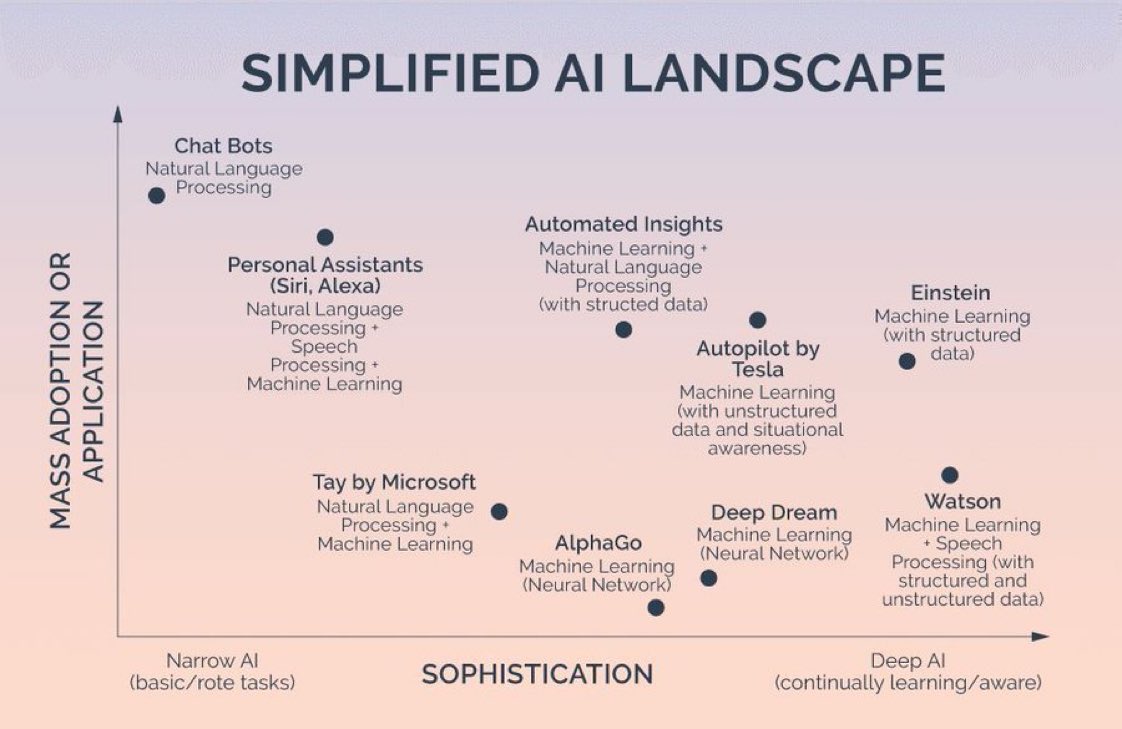
A simplified AI landscape

Haier, China Mobile and Huawei Launch the World's First AI+5G Interconnected Factory
Haier, China Mobile, and Huawei jointly launched the world’s first AI+5G interconnected factory at the 2019 World Industrial Internet Conference (WIIC) in Qingdao. This improvement refines future smart manufacturing by innovating and transforming enterprise organizations, business models, and ICT technologies, and integrating key technologies such as AI and 5G.
China Mobile Shandong and Huawei helped complete 5G base station deployment for Haier’s interconnected factory in Zhongde Industrial Park, Huangdao District, Qingdao on June 13, 2019. Read More
 Rick's Cafe AI