

You might have noticed a new term, “composite AI,” floating around the cybersphere. Don’t worry–it’s not a complex new technology that you must master. In fact, while the term may be new, the core idea behind it is not. Nevertheless, it’s likely a technique that you should be thinking about incorporating in your enterprise AI processes.
Gartner helped put composite AI on the map last summer, when it published its 2020 Hype Cycle for Emerging Technologies. Simply put, Composite AI refers to the “combination of different AI techniques to achieve the best result,” according to Gartner. That’s it. Simple enough, right? Read More
Tag Archives: Artificial Intelligence
The Autodidactic Universe
We present an approach to cosmology in which the Universe learns its own physical laws. It does so by exploring a landscape of possible laws, which we express as a certain class of matrix models. We discover maps that put each of these matrix models in correspondence with both a gauge/gravity theory and a mathematical model of a learning machine, such as a deep recurrent, cyclic neural network. This establishes a correspondence between each solution of the physical theory and a run of a neural network.
This correspondence is not an equivalence, partly because gauge theories emerge from N → ∞ limits of the matrix models, whereas the same limits of the neural networks used here are not well-defined.
We discuss in detail what it means to say that learning takes place in autodidactic systems, where there is no supervision. We propose that if the neural network model can be said to learn without supervision, the same can be said for the corresponding physical theory.
We consider other protocols for autodidactic physical systems, such as optimization of graph variety, subset-replication using self-attention and look-ahead, geometrogenesis guided by reinforcement learning, structural learning using renormalization group techniques, and extensions. These protocols together provide a number of directions in which to explore the origin of physical laws based on putting machine learning architectures in correspondence with physical theories. Read More
Data Science vs. Artificial Intelligence – What are the Differences?
With technological advancement, there are so many career opportunities that have come up. Surely, you might be aware of Artificial intelligence and data science. Well, these two are the most crucial technologies that are trending in today’s time. It is highly in demand across the globe and which is why the individuals with desired skills are also in demand. Since you may wonder what exactly the difference between the two is, let us explore this post in a better way. It is the data science that uses artificial intelligence in certain of the operations but not entirely. Data science also contributes to AI to some extent. Many people are in understanding that contemporary Data Science is nothing but Artificial Intelligence, but that is not true at all. Let us understand more about Data Science vs. Artificial Intelligence for clarity. Read More
Artificial intelligence in longevity medicine
Recent advances in deep learning enabled the development of AI systems that outperform humans in many tasks and have started to empower scientists and physicians with new tools. In this Comment, we discuss how recent applications of AI to aging research are leading to the emergence of the field of longevity medicine. Read More
Tech giants open up about their algorithms
Google, Facebook, TikTok and others are starting to talk more about how their algorithms work in a bid to win trust.
Yes, but: It’s hard to know what isn’t being revealed.
- Google on Monday published a blog post that shows users how to access more information about their search results, the day ahead of its Q4 earnings report.
- Facebook similarly released a post last week about how its News Feed algorithm works the day before its Q4 earnings.
- TikTok last year, amid the threat of a ban from the Trump administration, walked Axios and other reporters through an extensive presentation of how its prized algorithm works.
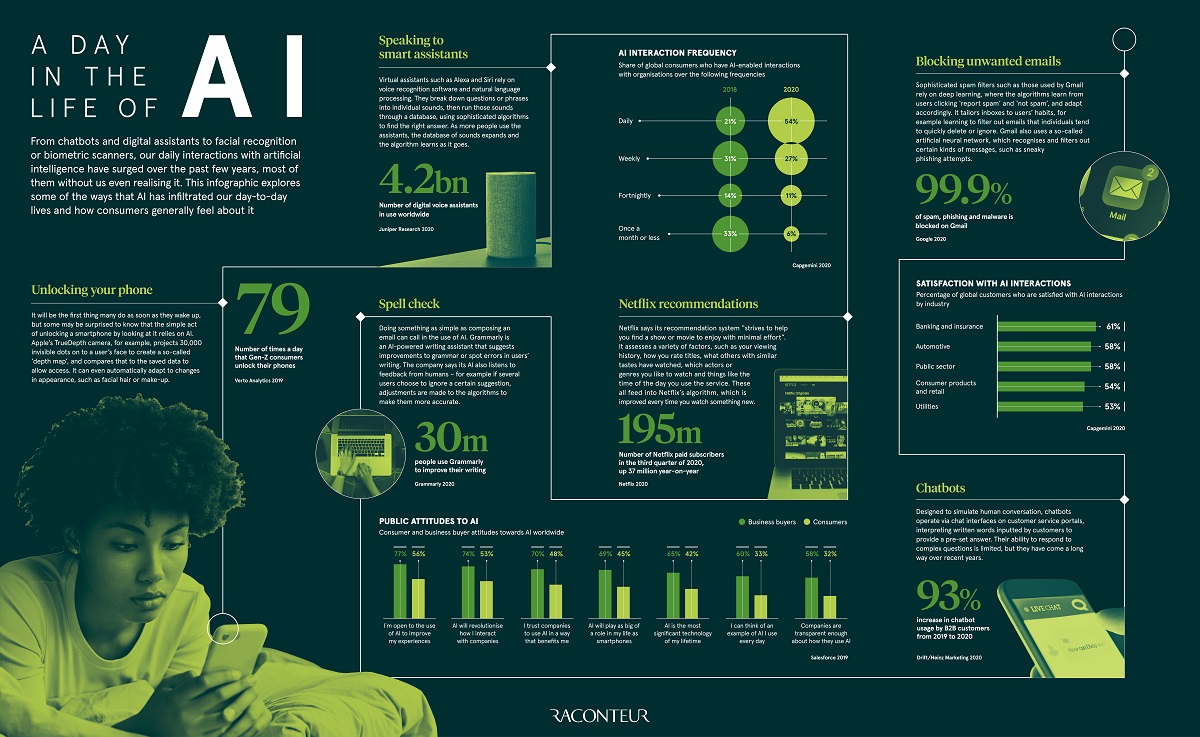
A day in the life of AI
Interesting AI papers published in 2020
A curated list of AI papers by Ajit Jaokar, based on his research and teaching, divided into Core, ones influencing how AI algorithms could develop in future, and Interesting, based on his interests. Read More
A Student Uses A.I. to Write a New Hamilton Song
Advanced Analytics and AI: Two Divergent But Synergistic Capabilities
Two commonly cited use cases for advanced analytics across financial services entail risk management and fraud detection; specifically, the use of advanced analytics to detect and reduce incidents of false positives.
Many financial services institutions (FSIs) are still working on optimizing these solutions and contrary to what some may believe, artificial intelligence has not rendered advanced analytics obsolete. In fact, many robust AI solutions rely on insights weaned through advanced analytics, and those organizations that are not yet ready to hand off their reins entirely to AI may find solace in mastering advanced analytics first. Read More
4 Intersecting Domains That You Can Easily Confuse with Artificial Intelligence
Once you start consuming machine learning content such as books, articles, video courses, and blog posts, you will often see the terms like artificial intelligence, machine learning, deep learning, big data, and data science being used interchangeably. These terms represent several closely related areas within the field of artificial intelligence. They are usually used interchangeably without adequate attention paid to their scopes. It’s not entirely the authors’ fault since there is a slight ambiguity about these terms’ differences. With this post, we will put an end to this ambiguity and clarify their scopes, covering: Artificial Intelligence, Machine Learning. Deep Learning, Data Science, and Big Data. Read More
 Rick's Cafe AI