

Many people who are already data scientists or new to the field of data science are looking at an answer to the question “Will AutoML (Automated Machine Learning) replace data scientists?” Asking a question like this is very reasonable because Automation has already been introduced to Machine Learning and it plays a key role in the modern world. In addition to that, people who want to become data scientists are thinking about ways to secure a spot in the job market for a long period of time.
AutoML will NOT replace your data science profession. It’s just here to make things easier for you, such as assisting you in boring repetitive tasks, saving your valuable time, assisting you in code maintenance and consistency, etc!
Let’s walk through the steps of a machine learning process to find out why. Read More
Tag Archives: Data Science
A data science book for kids!
The team at Domino Data Lab has cracked open their crayon box to write and illustrate the world’s first-ever children’s book about data science. Introduce your kids to Florence the Data Scientist and Her Magical Bookmobile! Read More
9 Comprehensive Cheat Sheets For Data Science
Sometimes we need a short and to-the-point resource.
In this age of technology, if you ever need to find information about any topic — tech-related or not — you can head to Google, and you will find thousands of materials, articles, books, and videos about that topic. Although this easy access to information had allowed many people worldwide to learn new skills, start a new career and explore topics from the comfort of their home, sometimes the massive amount of information can be overwhelming.
When you look for something and end up with so much information, it can get frustrating and confusing because you don’t know where to start, and at the beginning, it is difficult to see the big picture. Situations like this have lead to the appearance of cheat sheets.
Cheat sheets are an amazing resource for shortcut information about a certain topic. Often, cheat sheets are useful in many ways, but mainly initially, so you can grasp the main concepts and build stones of the topic you’re searching for. In case you want to refresh your memory and go through a straightforward reminder of the topic’s basics. Read More
A Chat with Andrew on MLOps: From Model-centric to Data-centric AI
A ‘Glut’ of Innovation Spotted in Data Science and ML Platforms
These are heady days in data science and machine learning (DSML) according to Gartner, which identified a “glut” of innovation occurring in the market for DSML platforms. From established companies chasing AutoML or model governance to startups focusing on MLops or explainable AI, a plethora of vendors are simultaneously moving in all directions with their products as they seek to differentiate themselves amid a very diverse audience.
“The DSML market is simultaneously more vibrant and messier than ever,” a gaggle of Gartner analysts led by Peter Krensky wrote in the Magic Quadrant for DSML Platforms, which was published earlier this month. “The definitions and parameters of data science and data scientists continue to evolve, and the market is dramatically different from how it was in 2014, when we published the first Magic Quadrant on it.”
The 2021 Magic Quadrant for DSML is heavily represented by companies to the right of the axis, which anybody who’s familiar with Gartner’s quadrant-based assessment method knows represents the “completeness of vision.” No fewer than 13 of the 20 vendors to make the quadrant’s cut landed on the right side, which indicates active innovation. Read More

Data Scientists are Increasingly Deserting their Jobs. But Why?
According to a report, data scientists spend two hours a week searching for new jobs
‘I’m a data scientist,’ feels pretty prestigious to say this, isn’t it? Then why is there a downward trend recently in data science professions, and especially, among data scientists? Lately, for over a couple of years, data scientists are quitting their jobs from top technology companies. Despite getting paid handsomely, they choose to walk out on many scenarios. The worst case is that most of them don’t even complete a whole year in the company.
…Data scientist was named as the ‘sexiest job of the 21st century’ by Harvard Business Review not long back. Starting from Fortune 500 companies to retail stores, organizations around the world want to build a team of top data science professionals to drive their company towards success.
Despite getting a lot of attention for a long time, the positive trend is taking a u-turn in recent years. According to Financial Time’s investigation, data scientists are spending an average of two hours a week looking for a new job. While machine learning specialists topped the list of developers who said they were looking for a new job, at 14.3%, data scientists followed the trend with 13.2%. Read More
Data Science vs. Artificial Intelligence – What are the Differences?
With technological advancement, there are so many career opportunities that have come up. Surely, you might be aware of Artificial intelligence and data science. Well, these two are the most crucial technologies that are trending in today’s time. It is highly in demand across the globe and which is why the individuals with desired skills are also in demand. Since you may wonder what exactly the difference between the two is, let us explore this post in a better way. It is the data science that uses artificial intelligence in certain of the operations but not entirely. Data science also contributes to AI to some extent. Many people are in understanding that contemporary Data Science is nothing but Artificial Intelligence, but that is not true at all. Let us understand more about Data Science vs. Artificial Intelligence for clarity. Read More
Datasets for Machine Learning and Deep Learning
— Some of the Best Places to Explore — A curated list of dataset repositories for deep learning projects and good places to look for additional benchmark datasets for your model, so I am putting it out here, hoping you find it useful! Read More
98 things that can go wrong in an ML project
…This is a long post divided the post into 6 categories. Feel free to read categories that relate best to your role as a data engineer, data scientist, ML engineer, data-business leader:
- ML Problem definition: The formative stage of defining the scope, value definition, timelines, governance, resources associated with the deliverable.
- Dataset Selection: This stage can take a few hours or a few months depending on the overall data platform maturity and hygiene. Data is the lifeblood of ML, so getting the right and reliable datasets is supercritical.
- Data Preparation: Real-world data is messy. Understanding data properties and preparing properly can save endless hours down the line in debugging.
- ML Model Design: This phase involved feature selection, decomposing the problem, and formulating the right model algorithms.
- Model Training: Building the model, evaluating with the hold-out examples, and online experimentation.
- Operationalize in Production: This is the post-deployment phase involving observability of the model and ML pipelines, refresh of the model with new data, and tracking success metrics in the context of the original problem.
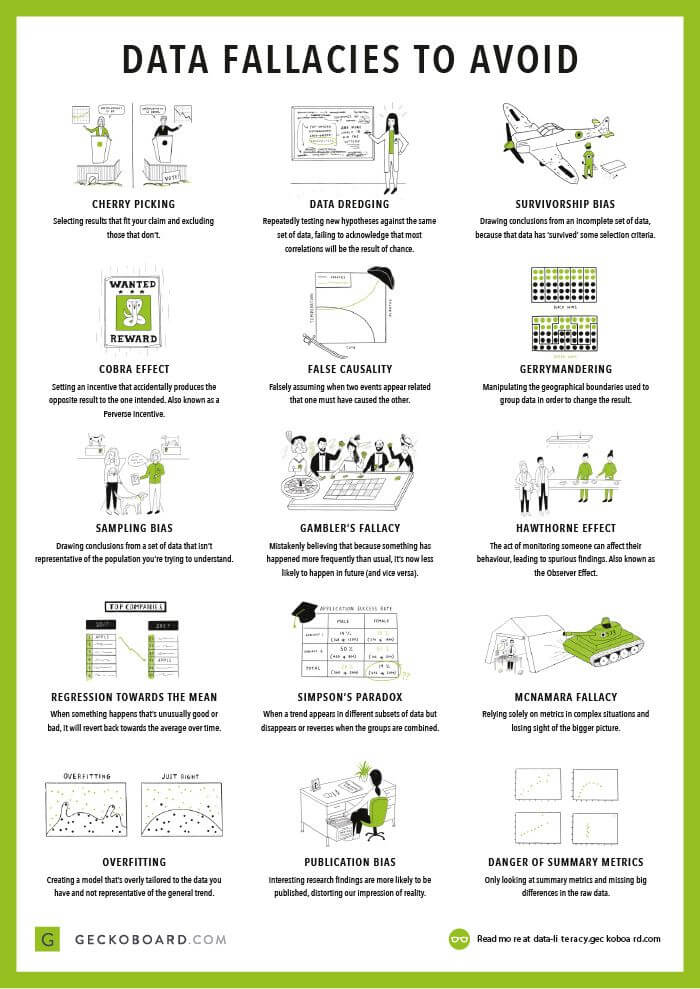
Data fallacies
Statistical fallacies are common tricks data can play on you, which lead to mistakes in data interpretation and analysis. Explore some common fallacies, with real-life examples, and find out how you can avoid them. Read More
 Rick's Cafe AI