Tag Archives: IoT

Deciding PaaS or SaaS for Building IoT Solutions in Microsoft Azure
Building out an IoT (Internet of Things) solution can be a difficult problem to solve. It sounds easy at first, you just connect a bunch of devices, sensors and such to the cloud. You write software to run on the IoT hardware and in the cloud, then connect the two to gather data / telemetry, communicate, and interoperate. Sounds easy, right? Well, it’s actually not as simple as it sounds. There are many things that can be difficult to implement correctly. The biggest problem area is Security, as it is in most other systems types as well. Then you can device management, cloud vs edge analytics, and many other aspects to a full IoT solution.
Traditionally you would need to build all this out yourself, however, with offerings from Microsoft there are a few options available for building out IoT solutions. The Azure IoT Suite offers PaaS (Platform as a Service) capabilities that are flexible for any scenario, while the newer Microsoft IoT Central is offering more managed SaaS (Software as a Service) capabilities to further assist in easing development, deployment and management. Read More
Edge computing and Artificial Intelligence: a new competitor for 5G
Edge computing combined with AI will allow to process enormous amounts of data locally. The additional cost of hardware accelerators is marginal. The computing performance of neural networks is boosted about ten times every year. The data can be processed in parallel, thereby outperforming traditional CPU design.
Usage of edge computing in applications such as self-driving cars, facial recognition or predictive maintenance is just the beginning. We will soon have enough computing power to build truly independently operating machines. They will be able to move safely in cities, factories and be almost as competent in their work duties as humans. Read More
The AI Edge Engineer: Extending the power of CI/CD to Edge devices using containers
The Artificial Intelligence – Cloud and Edge implementations course explores the idea of extending CI/CD to Edge devices using containers. This post presents these ideas under the framework of the ‘AI Edge Engineer’. Note that the views presented are personal; comments from those exploring similar ideas – especially in academia / research — are being sought.
The post discusses models of development for AI Edge Engineering based on deploying containers to Edge devices which unifies the Cloud and the Edge. Read More
WT2 Instant Translation, does it work?
What is Amazon Go, where is it, and how does it work?
Amazon will be opening more Amazon Go stores in the US and UK during 2019 – the latest rumour is that Amazon has now settled on a London site.
Amazon Go gives you the option to buy your goods from Amazon in person rather than through Amazon.com.
However, unlike other physical shops, it doesn’t have any registers or checkouts. You simply walk in, pick out what you want and walk out. Amazon is calling this a “Just Walk Out” shopping experience. Read More
Smart Cities and Components in the IoT Era
To cope with the increasing population, hyper-urbanization, globalization as well as to ensure economic and environmental stability, cities are now focusing on becoming smart cities. Smart City is a concept of utilizing technologies and connected data sensors to enhance and become powerful in terms of infrastructure and city operations. This includes monitoring and managing of public assets, transportation systems, citizens, power plants, water supplies, information systems, civil bodies, and other community services. As per the new study from Navigant Research, the global market for smart city services is expected to reach $225.5 billion within the next decade. Read More
Combine IIoT and Industry 4.0 for Competitive Advantage
IIoT is powerful, but when combined with an Industry 4.0 end-to-end strategic view, the opportunities are considerably greater, writes Martin Davis.
The Industrial Internet of Things (IIoT) is the grittier end of the Internet of Things (IoT) revolution that is sweeping the manufacturing sector. IIoT alone is estimated to deliver 10-25% productivity improvements, but when combined with analytics, automation, lean approaches, and artificial intelligence (AI) , as recommended by Industry 4.0, the opportunity is many times greater. Read More
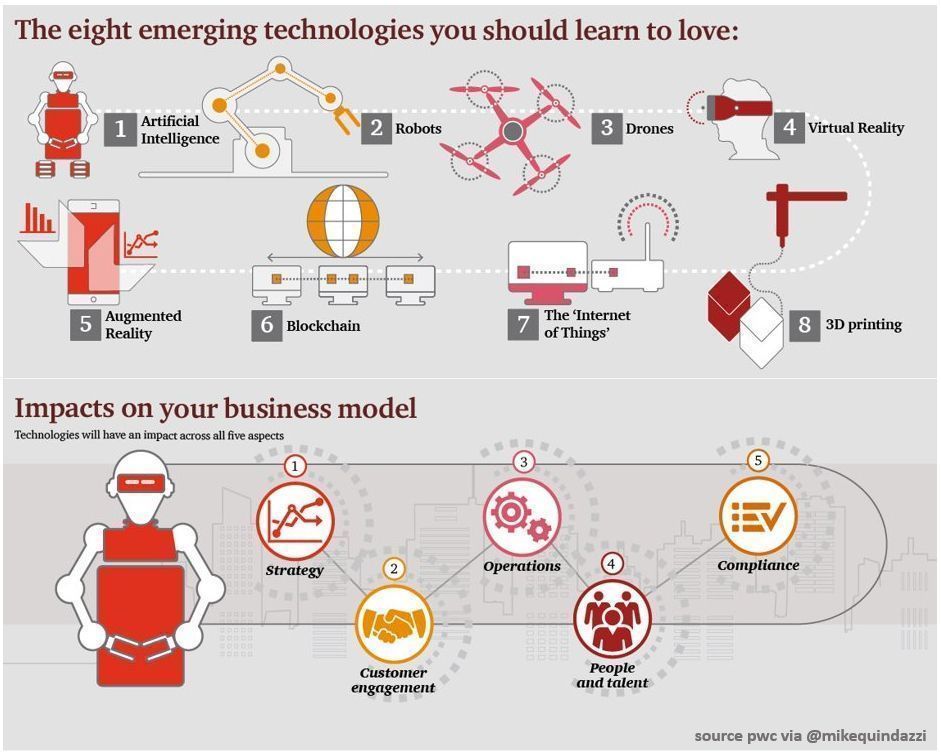
Eight technologies you should learn to love

How 5G, AI and IoT enable “Intelligent Connectivity”
Intelligent connectivity is a concept that foresees the combination of 5G, the Internet of Things and artificial intelligence as a means to accelerate technological development and enable new disruptive digital services. In the intelligent connectivity vision, the digital information collected by the machines, devices and sensors making up the Internet of Things is analysed and contextualised by AI technologies and presented to users in a more meaningful and useful way. This would both improve decision-making and allow delivery of personalised experiences to the users, resulting in a richer and more fulfilling interaction between people and the environment surrounding them.
As artificial intelligence becomes increasingly sophisticated thanks to advances in computing power, the education of data scientists and the availability of machine learning tools for creating advanced algorithms, the Internet of Things is getting closer to becoming a mainstream phenomenon. 5G represents the missing element to bring these technologies to new levels and enable the intelligent connectivity vision. The ultra-fast and ultra-low latency connectivity provided by 5G networks, combined with the huge amount of data collected by the Internet of Things and the contextualisation and decision-making capabilities of artificial intelligence technologies will enable new transformational capabilities in virtually every industry sector, potentially changing our society and the way we live and work. Read More
 Rick's Cafe AI