Artificial intelligence (AI) and blockchain are two of the most-talked-about technologies of the past 10 years, and their evolution has led to significant and promising innovations. The idea of combining them is particularly intriguing.
The profit potential for these two technologies is forecast to be in the billions for the foreseeable future. Gartner, a global technology research firm, estimates that the business value created by AI will near $3.9 trillion in 2022, while some anticipate the blockchain market will be worth roughly $23 billion by 2023.
The drivers behind this tremendous predicted growth are increased adoption, as well as the potential use cases that have been emerging across both sectors. AI, which is technically not a new technology, has taken on a prominent role in the tech world over the past two years. While we are still far from fully thinking machines, AI has been deployed in everything from marketing and sales to manufacturing and even health care. The technology has become a crucial part of most businesses’ plans moving forward. Read More
Tag Archives: Artificial Intelligence
Data in the Life: Authorship Attribution in Lennon-McCartney Songs
The songwriting duo of John Lennon and Paul McCartney, the two founding members of the Beatles, composed some of the most popular and memorable songs of the last century. Despite having authored songs under the joint credit agreement of Lennon-McCartney, it is well-documented that most of their songs or portions of songs were primarily written by exactly one of the two. Furthermore, the authorship of some Lennon-McCartney songs is in dispute, with the recollections of authorship based on previous interviews with Lennon and McCartney in conflict. For Lennon-McCartney songs of known and unknown authorship written and recorded over the period 1962-66, we extracted musical features from each song or song portion. These features consist of the occurrence of melodic notes, chords, melodic note pairs, chord change pairs, and four-note melody contours. We developed a prediction model based on variable screening followed by logistic regression with elastic net regularization. Out-of-sample classification accuracy for songs with known authorship was 76%, with a c-statistic from an ROC analysis of 83.7%. We applied our model to the prediction of songs and song portions with unknown or disputed authorship. Read More
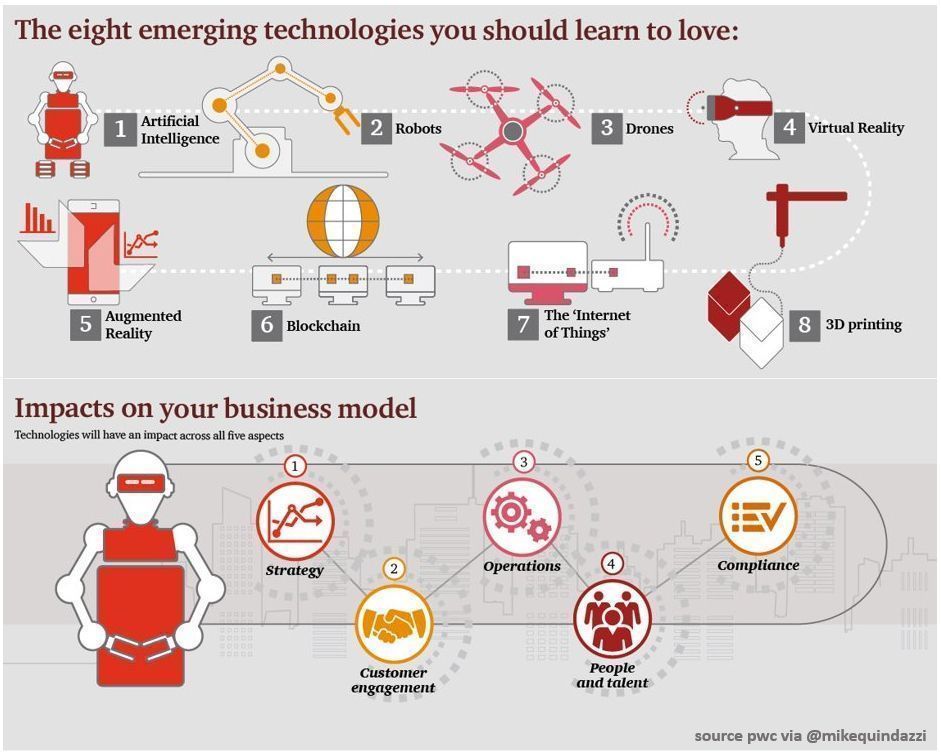
Eight technologies you should learn to love

A new AI is Using News Outlets to Produce Fake Article and it is quite Concerning!
Over the last few years, the rise of fake news and information has been off the charts. To tackle this issue, various measures have been implemented. Most recently, the Allen Institute for Artificial Intelligence developed Grover.
Grover is basically a neural network that can produce fake articles by imitating the writing style of actual journalists. The motivation behind its creation is to identify fake news, and generate fake stories as well. Read More
New AI programming language goes beyond deep learning
A team of MIT researchers is making it easier for novices to get their feet wet with artificial intelligence, while also helping experts advance the field.
In a paper presented at the Programming Language Design and Implementation conference this week, the researchers describe a novel probabilistic-programming system named “Gen.” Users write models and algorithms from multiple fields where AI techniques are applied — such as computer vision, robotics, and statistics — without having to deal with equations or manually write high-performance code. Gen also lets expert researchers write sophisticated models and inference algorithms — used for prediction tasks — that were previously infeasible. Read More
A General-Purpose Probabilistic Programming System with Programmable Inference
Although probabilistic programming is widely used for some restricted classes of statistical models, existing systems lack the flexibility and efficiency needed for practical use with more challenging models arising in fields like computer vision and robotics. This paper introduces Gen, a generalpurpose probabilistic programming system that achieves modeling flexibility and inference efficiency via several novel language constructs: (i) the generative function interface for encapsulating probabilistic models; (ii) interoperable modeling languages that strike different flexibility/efficiency tradeoffs; (iii) combinators that exploit common patterns of conditional independence; and (iv) an inference library that empowers users to implement efficient inference algorithms at a high level of abstraction. We show that Gen outperforms state-of-the-art probabilistic programming systems, sometimes by multiple orders of magnitude, on diverse problems including object tracking, estimating 3D body pose from a depth image, and inferring the structure of a time series. Read More
How 5G, AI and IoT enable “Intelligent Connectivity”
Intelligent connectivity is a concept that foresees the combination of 5G, the Internet of Things and artificial intelligence as a means to accelerate technological development and enable new disruptive digital services. In the intelligent connectivity vision, the digital information collected by the machines, devices and sensors making up the Internet of Things is analysed and contextualised by AI technologies and presented to users in a more meaningful and useful way. This would both improve decision-making and allow delivery of personalised experiences to the users, resulting in a richer and more fulfilling interaction between people and the environment surrounding them.
As artificial intelligence becomes increasingly sophisticated thanks to advances in computing power, the education of data scientists and the availability of machine learning tools for creating advanced algorithms, the Internet of Things is getting closer to becoming a mainstream phenomenon. 5G represents the missing element to bring these technologies to new levels and enable the intelligent connectivity vision. The ultra-fast and ultra-low latency connectivity provided by 5G networks, combined with the huge amount of data collected by the Internet of Things and the contextualisation and decision-making capabilities of artificial intelligence technologies will enable new transformational capabilities in virtually every industry sector, potentially changing our society and the way we live and work. Read More
How the combination of 5G, AI, Big Data and IoT is set to change everything
The combination of 5G, artificial intelligence (AI), smart platforms and the Internet of Things (IoT) form the basis of what we call ‘Intelligent Connectivity’. With more than 5.1 billion unique subscribers and nearly 9 billion connections globally, mobile is already one of the most widely deployed technology platforms ever. However, Intelligent Connectivity takes this further and marks the beginning of an era of highly contextualised and personalised experiences, underpinned by ubiquitous hyper connectivity. It is set to impact almost every aspect of our daily lives from the way we consume entertainment to the way in which we learn and interact with colleagues. It will give people the information they need in an instant making our lives more productive and efficient. It will impact how entire industries innovate and operate, how societies interact and thrive and how economies flourish. Read More
An alliance is being forged between 5G and artificial intelligence
The proposed vision for 5G technology is revolutionary, and its architecture truly innovative. It offers features that enhance not only network performance, but also the way networks are built and deployed. This is an essential aspect because one of the drivers for 5G is the reduction in both CAPEX and OPEX, which will open the door for more players offering more innovative business models.
Today, an alliance is being forged between 5G and artificial intelligence (AI) that together will be pillars of the digital transformation of millions of businesses around the globe. 5G’s technological proposition is aimed at closing the cycle on the network convergence between fixed and mobile. This means that 5G architectures and technology will allow the migration of all the services that are today dependent of fixed connections (namely fibre) to mobile (ubiquitous) connectivity, enhancing the existing portability to become true mobility of services. Read More
The fourth Industrial revolution emerges from AI and the Internet of Things
Big data, analytics, and machine learning are starting to feel like anonymous business words, but they’re not just overused abstract concepts—those buzzwords represent huge changes in much of the technology we deal with in our daily lives. Some of those changes have been for the better, making our interaction with machines and information more natural and more powerful. Others have helped companies tap into consumers’ relationships, behaviors, locations and innermost thoughts in powerful and often disturbing ways. And the technologies have left a mark on everything from our highways to our homes. Read More
 Rick's Cafe AI