
Tech giants open up about their algorithms

Google, Facebook, TikTok and others are starting to talk more about how their algorithms work in a bid to win trust.

Yes, but: It’s hard to know what isn’t being revealed.

  • Google on Monday published a blog post that shows users how to access more information about their search results, the day ahead of its Q4 earnings report.
  • Facebook similarly released a post last week about how its News Feed algorithm works the day before its Q4 earnings.
  • TikTok last year, amid the threat of a ban from the Trump administration, walked Axios and other reporters through an extensive presentation of how its prized algorithm works.
Read More

#artificial-intelligence, #big7

The AI Squad

According to Mark Cuban, “The companies that have harnessed AI the best are the companies dominating. To paraphrase a great movie line, ‘They keep getting smarter while everyone else stays the same ‘ It’s the foundation of how I invest in stocks these days. ‘How good is the company at AI’ ” This “AI Squad” includes the US based members of the Big 7: Alphabet, Amazon, Facebook, and Microsoft, plus Apple. Read More

#big7

Artificial intelligence researchers rank the top A.I. labs worldwide

Artificial intelligence researchers don’t like it when you ask them to name the top AI labs in the world, possibly because it’s so hard to answer.

U.S. Big Tech — Google, Facebook, Amazon, Apple and Microsoft — have all set up dedicated AI labs over the last decade.

There’s also DeepMind, which is owned by Google parent company Alphabet, and OpenAI, which counts Elon Musk as a founding investor.

… “Reputationally, there is a good argument to say DeepMind, OpenAI, and FAIR (Facebook AI research]) are the top three,” according to Mark Riedl, associate professor at the Georgia Tech School of Interactive Computing. Read More

#big7

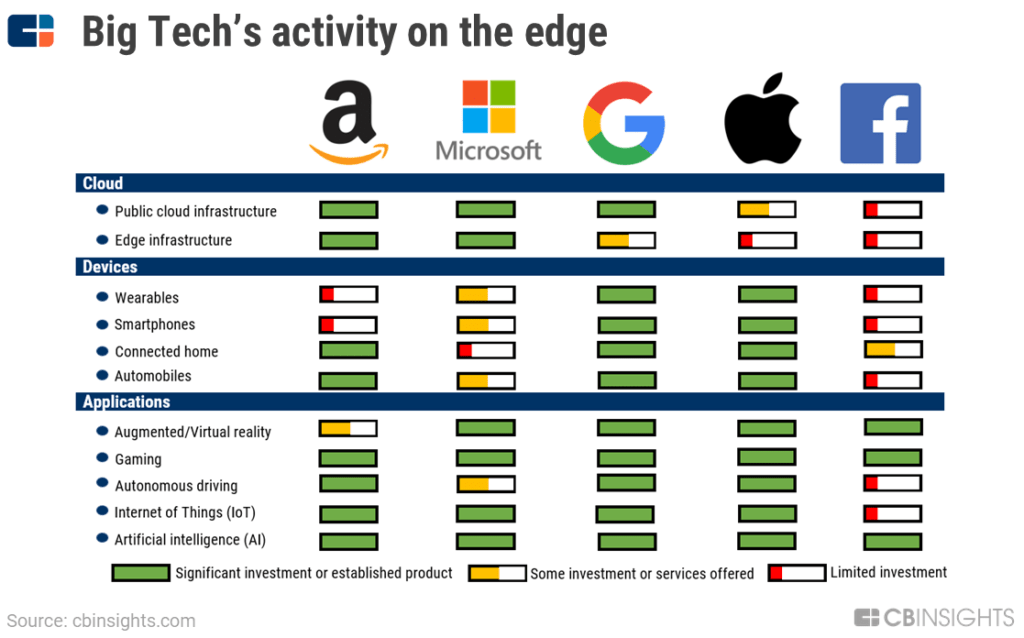
Big Tech In Edge Computing

With varying core competencies and sprawling businesses, each FAMGA member’s edge computing strategy is unique. Read more about each company’s approach to edge computing here.

Read More

#big7, #iot

Forget coding, you can now solve your AI problems with Excel

Machine learning and deep learning have become an important part of many applications we use every day. There are few domains that the fast expansion of machine learning hasn’t touched. …But mastering machine learning is a difficult process. You need to start with a solid knowledge of linear algebra and calculus, master a programming language such as Python, and become proficient with data science and machine learning libraries such as Numpy, Scikit-learn, TensorFlow, and PyTorch. And if you want to create machine learning systems that integrate and scale, you’ll have to learn cloud platforms such as Amazon AWS, Microsoft Azure, and Google Cloud.

… To most people, MS Excel is a spreadsheet application that stores data in tabular format and performs very basic mathematical operations. But in reality, Excel is a powerful computation tool that can solve complicated problems. Excel also has many features that allow you to create machine learning models directly into your workbooks. Read More

#big7, #machine-learning

What Happens When AI Has An Overactive Imagination?

Read More

#big7, #videos

Tech giants are giving China a Vital Edge in Espionage

U.S. officials say private Chinese firms have been enlisted to process stolen data for their country’s spy agencies.

In 2017, as U.S. President Donald Trump began his trade war with China, another battle raged behind the scenes. The simmering, decade long conflict over data between Chinese and U.S. intelligence agencies was heating up, driven both by the ambitions of an increasingly confident Beijing and by the conviction of key players in the new administration in Washington that China was presenting an economic, political, and national security challenge on a scale the United States had not faced for decades—if ever.

Beijing was giving China hawks in the United States plenty of ammunition. Read More

#big7, #china-vs-us, #ic

Alphabet’s Loon hands the reins of its internet air balloons to self-learning AI

Alphabet’s Loon, the team responsible for beaming internet down to Earth from stratospheric helium balloons, has achieved a new milestone: its navigation system is no longer run by human-designed software.

Instead, the company’s internet balloons are steered around the globe by an artificial intelligence — in particular, a set of algorithms both written and executed by a deep reinforcement learning-based flight control system that is more efficient and adept than the older, human-made one. The system is now managing Loon’s fleet of balloons over Kenya, where Loon launched its first commercial internet service in July after testing its fleet in a series of disaster relief initiatives and other test environments for much of the last decade. Read More

#big7, #reinforcement-learning, #robotics

AutoX becomes China’s first to remove safety drivers from robotaxis

Residents of Shenzhen will see truly driverless cars on the road starting Thursday. AutoX, a four-year-old startup backed by Alibaba, MediaTek and Shanghai Motors, is deploying a fleet of 25 unmanned vehicles in downtown Shenzhen, marking the first time any autonomous driving car in China tests on public roads without safety drivers or remote operators.

The cars, meant as robotaxis, are not yet open to the public, an AutoX spokesperson told TechCrunch. Read More

#china-ai, #robotics, #big7

Use real-time anomaly detection reference patterns to combat fraud

Businesses of every size and shape have a need to better understand their customers, their systems, and the impact of external factors on their business. How rapidly businesses mitigate risks and capitalize on opportunities can set apart successful businesses from businesses that can’t keep up. Anomaly detection—or in broader terms, outlier detection—allows businesses to identify and take action on changing user needs, detect and mitigate malignant actors and behaviors, and take preventive actions to reduce costly repairs.

The speed at which businesses identify anomalies can have a big impact on response times, and in turn, associated costs.

… At Google Cloud, our customer success teams have been working with an increasing number of customers to help them implement streaming anomaly detection. In working with such organizations to help them build anomaly detection systems, we realized that providing these reference patterns can significantly reduce the time to solution for those and future customers. Read More

#big7, #cyber